


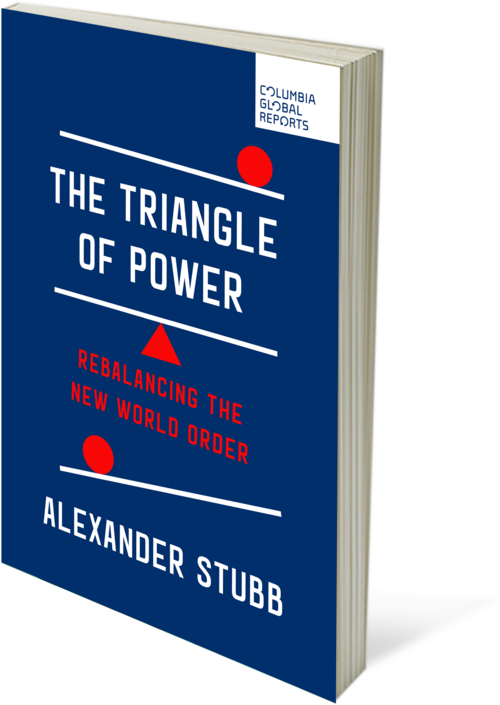
The Triangle of Power
Dear Reader,
Alexander Stubb, the American-educated President of Finland, occupies a naturally precarious place in the world, because his country has a very long border with a perpetually threatening Russia. Rather than keeping his head down, he has involved himself intensely in world affairs—recently as a member of a small delegation of European leaders who accompanied Volodymyr Zelensky to the White House to try to negotiate an end to the war in Ukraine.
President Stubb has used his position adjacent to the great-power struggles of the current moment to produce a dazzling overview of the world situation today. Using vivid anecdotes and powerful analysis, The Triangle of Power argues that as we enter the middle decades of the twenty-first century, the pivotal player will be not the United States or Russia or China but, collectively, the Global South, because it holds the balance of power. Stubb writes in a spirit of alarm. Russia’s invasion of Ukraine has made it especially clear that the global order is not inherently stable. It is no longer the case that the United States and a unified Europe stand strongly together, or that China is gradually coming into alignment with the West. And the fragmented, under-resourced Global South doesn’t see itself as naturally aligned with any of the major powers, so effective statecraft will require increased attention to its interests.
The Triangle of Power provides a rare, up-close view of world affairs at the highest level, including intimate descriptions of President Stubb’s private meetings with Donald Trump (his occasional golf partner), Xi Jinping, and Vladimir Putin. It is as good a place as there is to get an incisive, comprehensive overview of the world in 2026.
Sincerely,

Nicholas Lemann
Director, Columbia Global Reports
Stay in Touch
Subscribe to our regular newsletter to stay informed about our upcoming books, author events, and more.

Columbia Global Reports is a nonprofit publishing imprint from Columbia University that commissions authors to produce works of original thinking and on-site reporting from all over the world, on a wide range of topics.


© 2026 The Trustees of Columbia University in the City of New York. All Rights Reserved|
Site by ALINE, A Marketing Company