


Reading Our Minds
Dear Reader,
When you go to the doctor for a checkup, you’re likely to have your blood drawn and your temperature and blood pressure taken—and that’s if you’re completely healthy. If you’re sick, you may be subjected to an MRI, a CAT scan, an EKG, a biopsy, or other tests. Measurement is an essential part of medical diagnosis.
There is one major exception to this rule: mental health. A psychiatrist is likely to ask a new patient questions about her mental state, but not to use data generated by means beyond what the patient says. This is embedded custom, but it doesn’t have to be. There are new ways to get information about people’s mental health through measurement, as there are with other aspects of their health.
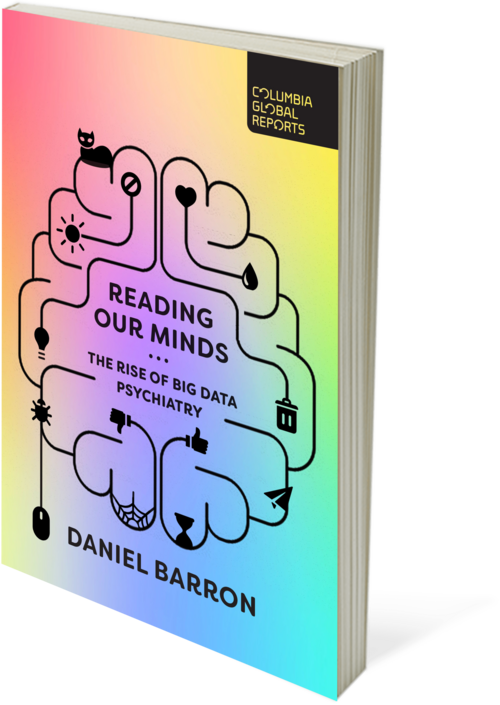
In Reading Our Minds, Dr. Daniel Barron, a brilliant young psychiatrist, lays out a number of ways of measuring mental health, none of which was available a generation ago. Doctors can track patients’ behavior online, which often tells a different story than the one they volunteer. They can use sensors to track patients’ movements. They can use artificial intelligence to analyze speech patterns. They can measure brain activity. Barron lucidly describes the experiments that cutting-edge, technologically oriented psychiatrists are using to explore these and other new techniques.
Barron’s account of what is now possible in psychiatry is fascinating, fresh, and compelling. His argument in favor of using new diagnostic tools will not persuade everyone. Surely there will be debates about whether and how to use them. Reading our Minds opens up a new frontier, which we can now begin to explore.
Sincerely,

Nicholas Lemann
Director, Columbia Global Reports
Stay in Touch
Subscribe to our regular newsletter to stay informed about our upcoming books, author events, and more.

Columbia Global Reports is a nonprofit publishing imprint from Columbia University that commissions authors to produce works of original thinking and on-site reporting from all over the world, on a wide range of topics.


© 2026 The Trustees of Columbia University in the City of New York. All Rights Reserved|
Site by ALINE, A Marketing Company