
The Infodemic
Dear Reader,
The COVID-19 pandemic has been an overwhelming global crisis—most obviously a crisis in public health, and almost as obviously an economic crisis. It has also, less obviously, been a crisis in democratic governance. At a time when democracy worldwide had been fraying, the pandemic offered leaders an opportunity to allow it to deteriorate further, in the name of crisis management. The effects of this may be felt long after the pandemic is over.
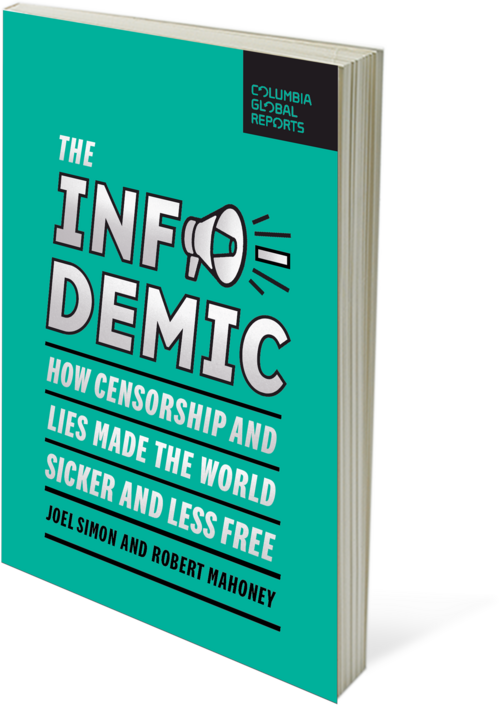
Joel Simon and Robert Mahoney, longtime senior leaders of the Committee to Protect Journalists, have a uniquely broad perspective on global responses to the pandemic. Drawing on the experiences of fifteen widely scattered countries, from Israel to Nicaragua and from the United States to China, they make a powerful argument that the free flows of information that are the oxygen democracy needs to survive have been substantially curtailed, not necessarily temporarily.
Government responses to the pandemic have triggered familiar reactions from left and right—one side advocating for more stringent health measures, the other for “freedom.” In The Infodemic, Simon and Mahoney make the case that these standard reactions mislead. Traditionally repressive governments, like China’s, restricted information about the pandemic. Flawed democracies, like United States during Donald Trump’s presidency, flooded the airwaves and the Internet with information that wasn’t true. No information and bad information are two sides of the same coin: they both made the pandemic more difficult to control, and they will both lead to the long-term worsening of democratic functioning. Simon and Mahoney have produced a clarion call for using the pandemic experience to strengthen our information ecosystem, as well as our public health system.
Best,

Nicholas Lemann
Director, Columbia Global Reports
Stay in Touch.
Subscribe to our regular newsletter to stay informed about our upcoming books, author events, and more.

Columbia Global Reports is a nonprofit publishing imprint from Columbia University that commissions authors to produce works of original thinking and on-site reporting from all over the world, on a wide range of topics.


© 2026 The Trustees of Columbia University in the City of New York. All Rights Reserved|
Site by ALINE, A Marketing Company