


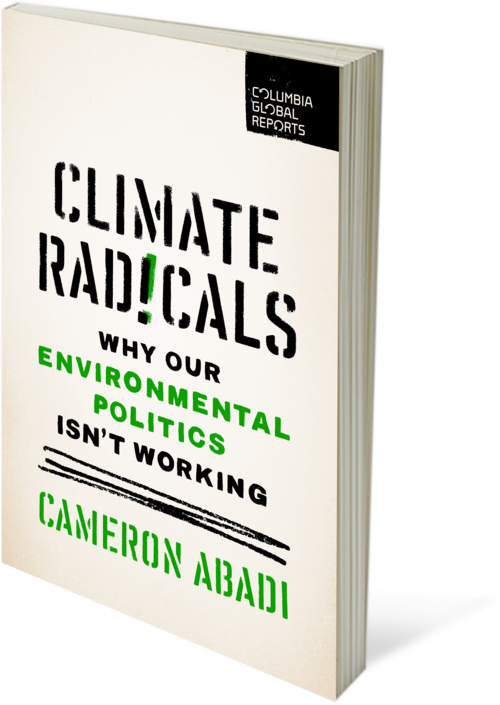
Climate Radicals
Dear Reader,
Germany should have been, and wanted to be, the major democracy that got climate policy right. Its population overwhelmingly recognizes climate change as a major issue and believes in serious reductions in carbon emissions. It has a powerful environmental party, the Greens, represented in its governing coalition. American-style climate denialism is not a significant part of German politics.
And yet, Germany has made surprisingly little progress toward reaching its carbon reduction goals, and its environmental movement, in frustration, has become increasingly radical in ways that alienate most of the German public and so may hurt the cause. In Climate Radicals, Cameron Abadi, Berlin-based deputy editor of Foreign Policy magazine, reports in depth on Germany’s failure to find its way to a climate policy that works. He gives us fascinating in-depth portraits of the leading figures in German environmental politics, including the leaders of the Greens and of three radical groups that aim to disrupt daily life as much as they can. In the larger sense, he takes on the difficult question of whether voters in a free society can be persuaded to support policies that entail short-term personal sacrifice for the sake of long-term environmental benefits.
Abadi also looks at the American Inflation Reduction Act of 2022, whose misleading name obscures the reality that it represents the most significant move toward green energy in American history. This law is, as Abadi puts it, “all carrots and no sticks”: it contains billions of dollars’ worth of financial incentives to individuals and businesses, including fossil-fuel businesses, and inflicts no real sacrifices on anybody. Abadi had looked at it more closely than most journalists, and what he found would not please environmental policy purists. But he leaves us wondering whether being conceptually impure might be the only way to create a successful climate politics.
Best,

Nicholas Lemann
Director, Columbia Global Reports
Stay in Touch.
Subscribe to our regular newsletter to stay informed about our upcoming books, author events, and more.

Columbia Global Reports is a nonprofit publishing imprint from Columbia University that commissions authors to produce works of original thinking and on-site reporting from all over the world, on a wide range of topics.


© 2026 The Trustees of Columbia University in the City of New York. All Rights Reserved|
Site by ALINE, A Marketing Company